
A Conversation with Jordan King
In late summer, 2025, we sat down to talk with our inaugural Artist in Residence, Jordan King, about how her time with the Creative Engagement Collaboratory helped catalyze her hybrid work, Sleep. Read on for that conversation on her experiences and intentions in creating this experimental and profound piece.
How do I reconcile the history I carry with me, bodily and sensorily?
Can you tell us a bit about yourself and the project that you worked on with CEC?
I’m a multi-disciplinary artist based in Toronto, working in video, film, photography, and performance. I was heavily involved in nightlife culture during my formative years. I organized events and cabaret performances, modelled in DIY fashion shows, and performed with a neo-burlesque troupe. That experimental period of my life still influences my artistic lens, I recently formalized my creative practice by completing a Master of Fine Arts degree at OCAD University in 2024.
For my residency with Creative Entanglement Collaboratory, I have created a hybrid performance/installation/video piece. I’ve been developing a scripted cabaret work since 2023, so when I was approached to be Artist in Residence, I initially planned to continue with that. But in the earliest phase of the residency, January-March 2025, I felt the need to challenge myself by distilling, or simplifying the core concept that I was processing in the cabaret work. These were questions about: What is my place in the artistic landscape now? As I age, and my body changes, how can I retain a sense of connection to it? What am I experiencing as I enter a new decade of life? How do I reconcile the history I carry with me, bodily and sensorily?
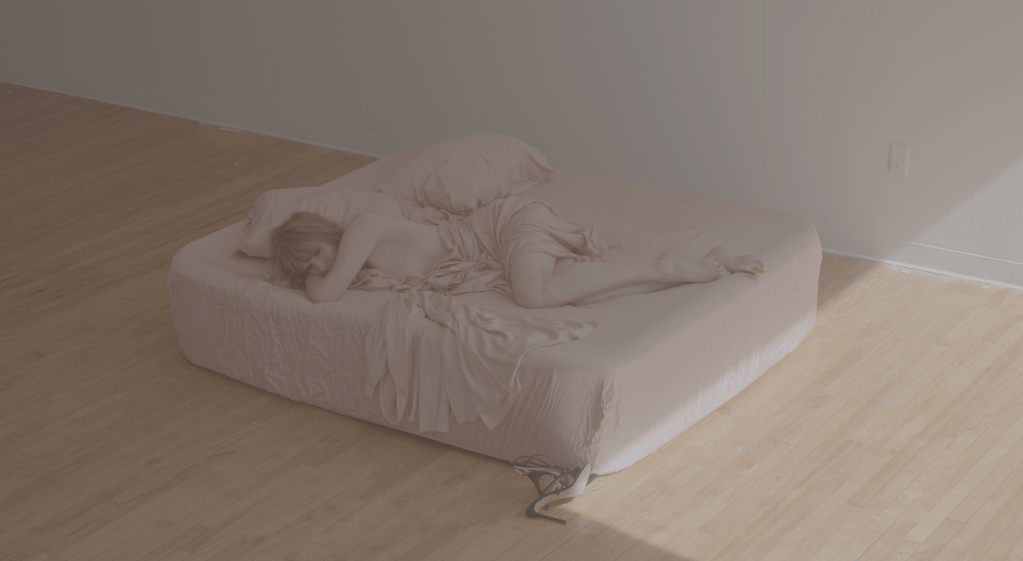
I also sought to create a work that could be experienced in a more multi-sensory way by viewers or visitors to a gallery. This approach began during my time as a grad student at OCAD when I started to consider ways art and performance can engage multiple senses, offering experiences to a variety of audiences without favouring any one single sense. A great deal of art presented in museums and galleries has historically been reliant on the sense of sight, and while I don’t yet know if all artwork can engage all senses equally, I sought to create a work that was not solely reliant on sight for engagement with it.
What themes or questions does your work explore and how have those come through in, Sleep, your current CEC project?
I’m considering themes of aging and my social role with this work. Throughout my life, I have understood the power one’s body and appearance can wield. For feminine, able-bodied individuals, this shifts over time, which is natural and part of the aging process. Broadly speaking, in Western dominant culture there are certain ageist attitudes and gender expectations foisted onto feminine bodies, and while I am now experiencing this myself, rather than fear it, I sought to engage it in this work. An additional layer is understanding this process as a trans-feminine person, both individually and as an artist.
What did you hope to explore or achieve during your time with CEC and how did your time in the residency look and feel in the end?
My intention from early on was to produce an entirely new work, even if the form of that work was not clear at the beginning. I split the time up into two portions. January – March was spent reading, researching, and planning. April – June was for pre-production, production, and post-production. This can be helpful with a long residency period, for example one year or six months, where initially it seems like there’s plenty of time and then quickly, time disappears. The only real shift from my expectations was that I initially intended to present Sleep publicly in some form, but ultimately chose not to just yet. The pre-production and production phases were quite a lot to complete. And a public presentation is a whole additional set of tasks. As well, I want to take time to consider the correct venue to present the work in, which will likely be in a gallery, or perhaps as part of a performance series. Trying to determine that in a six month period did not seem possible.
The residency period supported the development, creation and production of the work, even if the public presentation did not happen. I was able to conduct extensive research, (reading, drawing, design), tactile exploration (considering fabric choices, visual elements), and design of the performance (lighting, positioning, movement).
What advice would you give to other artists applying for residencies?
For artists, I think having a few concepts in motion is necessary. If there is only one major project that seems the most vital to get underway, the right residency or the right funding source may take a long time to arrive or never arrive at all. There are many different types of residencies, some provide access to rehearsal space, some offer production space, some offer time away from routine and responsibilities to think and plan. Having creative tangents such that a creative residency (which the Creative Entanglement Collaboratory Residency was for me) can provide time to explore a new idea or direction is ideal. This particular residency was hugely helpful for developing new artistic approaches. Although I truly hoped to develop a cabaret work for a live audience and attempted to do that for almost three years, the CEC residency, with its emphasis on research creation, helped me focus into a deeper, more experimental mode, much different from the same idea I’d had on my mind since 2022.
What advice would you give to teams supporting artists through programs like residencies?
For teams or organizations, parameters and check-ins are extremely helpful. These might simply be defining what the final deliverable will be, even if the outcome is not entirely certain.
Patience with the final wrap up period is also extremely helpful for artists, as the beginning phase often feels quite open-ended, while the completion can, of course, feel time limited.
There does need to be adherence to deadlines though, and while these suggestions might sound a bit detached from a more cerebral artistic process, they are sometimes the most crucial in ensuring the work has both flexibility before being ‘finished’ and an end-point in mind.
What has surprised you most during this residency and your process creating Sleep? Can you share a moment from the residency and research creation process that has stood out to you as particularly impactful?
The surprise component for me in creating this work was the profound sensorial experience of the performance itself. Despite the seemingly simple design of this performance, both the focused time in the studio, the soundscape (which can be heard in the video documentation), and the quiet meditation while in the studio have stayed with me. For most, if not all, of my past performance work, I felt an internal obligation to consider and attend to the most impactful visual elements, costume, movement, choreography, staging, always with a live audience in mind. Yet the simplicity of this piece, just two costume items, one set piece, and a duration of time, allowed for a much more expansive experience.
 Creative Entanglement Collaboratory